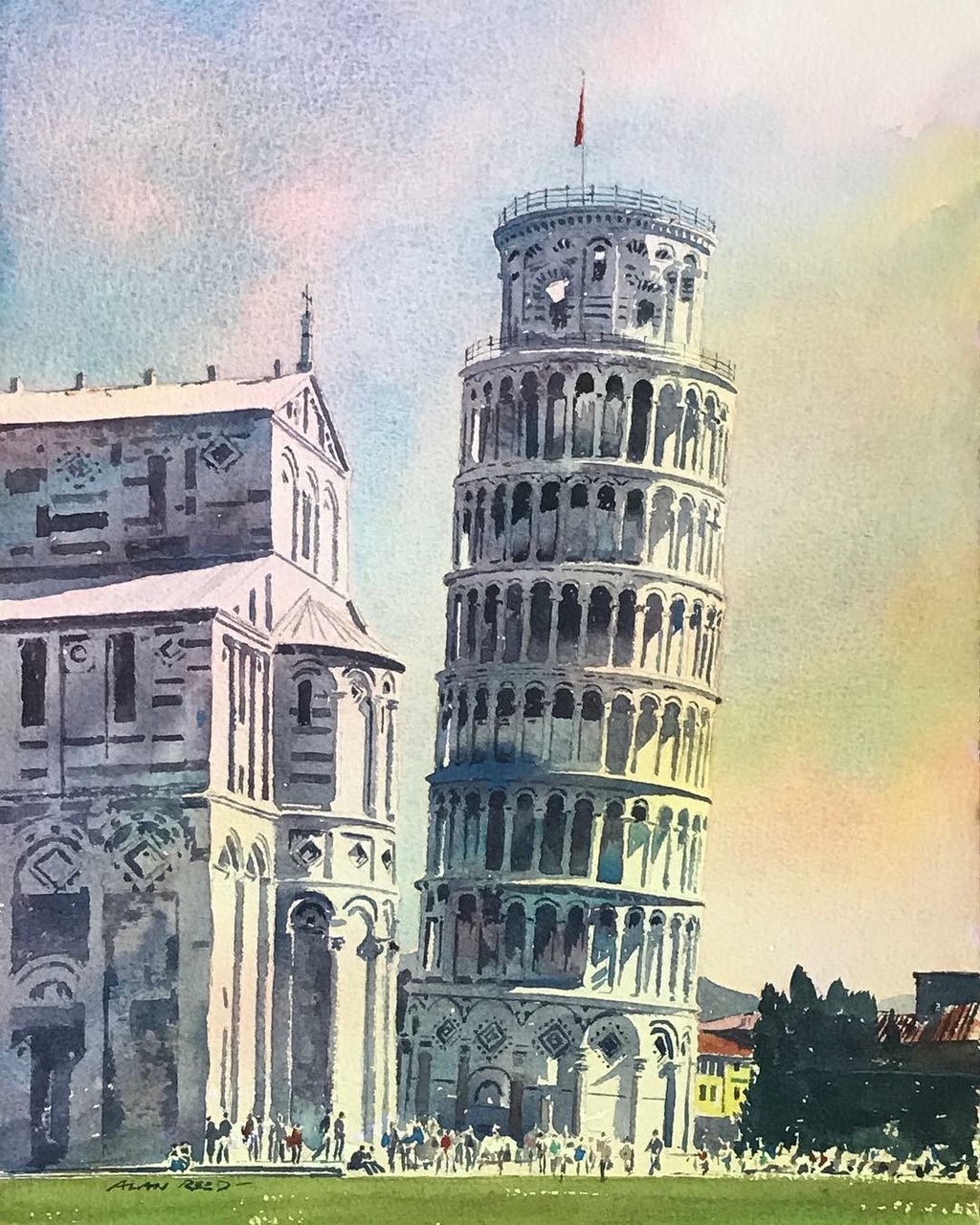
Leaning Tower of Pisa
This original watercolour painting is based on a small sketchbook study painted on location.
The Leaning Tower of Pisa is the campanile, or freestanding bell tower, of Pisa Cathedral. It is known for its nearly four-degree lean, the result of an unstable foundation. The tower is one of three structures in Pisa’s Cathedral Square, which includes the cathedral and Pisa Baptistry.
The Tilt
Famous for its unintended tilt, the 56m tower took nearly 200 years to build – work started in 1173.
Five years later it started tilting.
The tilt was noticeable as workers built the second floor, caused by the shallow foundations of 3m and unstable subsoil.
Engineers working on the tower in later years built upper floors with one side shorter than the other trying to compensate. This meant the structure is curved as well as tilting.
Work was slow and sometimes abandoned for decades as Pisa was often at war with nearby Florence, Genoa and other city states.
The leaning tower of Pisa was finally completed in 1372.
Attempts were made throughout history to correct the problem. However, Some of them made it worse and by the 1990s there were fears the tower could collapse altogether.
The Italian government appointed a ‘committee of 13 experts’ to come up with a plan to save the tower in 1990. The team was led by British engineering expert, John Burland.